Breast Anatomy 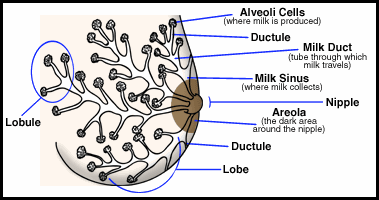 What is the main function of the female breast? To produce milk for babies – of course! Each breast has glands that produce milk from the nutrients and water taken from Mom’s bloodstream. What is the main function of the female breast? To produce milk for babies – of course! Each breast has glands that produce milk from the nutrients and water taken from Mom’s bloodstream.
Milk ducts carry the milk from the milk glands to the nipple. The system of milk glands and ducts resembles several bunches of grapes. Milk glands and ducts are organized into several clusters that are called lobes. The breast actually has 15-20 of these. From outside, the lobes feel like little lumps especially during the days before you get your monthly period. 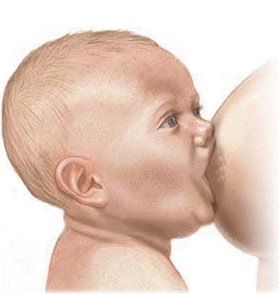
The space in between the lobes is filled with connective and fatty tissue. Fat also surrounds the whole system of milk ducts and glands. Usually the breasts of young women are mainly glandular tissue and that is why their breasts are firmer. Fattier breasts are usually softer. Lactating Breast AnatomyThe reddish part surrounding the nipple is called the areola. Areolas usually grow in size and get darker during pregnancy – creating a “target” for the baby to latch onto. The little pimple-like bumps on the areola are called Montgomery glands, and they produce oil that lubricates the nipple and areola. The nipple has several tiny openings in it through which the milk flows. Get familiar with your breast anatomy and learn how to do a self exam. You can get to know your own breasts by doing routine breast self-exams. By doing a monthly breast self-exam, you learn how your breasts feel. This helps you detect any changes or signs of a problem. All women should do the exam once a month. This includes women who * have gone through menopause * are pregnant * are breast-feeding * have breast implants A breast self-exam is done to detect changes that could lead to breast cancer. To learn what is normal for your breasts and to find any problems, you should do a breast self-exam once a month.
|